The Claim
Sri Lanka’s 2019 tax cuts are often blamed for the sharp drop in government revenue in 2020.
The Reality
The data tells a different story. Government revenue didn’t collapse because of tax cuts. It collapsed because the economy shut down.
The Big Number
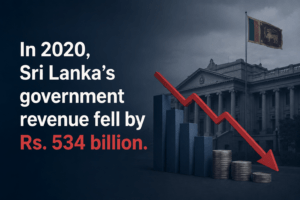
In 2020, Sri Lanka’s government revenue fell by Rs. 534 billion.
The key question is: where did that loss actually come from?
Breakdown of Revenue Loss
- Rs. 323 billion → Economic contraction due to COVID-19
- Rs. 136 billion → Import restrictions
- Rs. 75 billion → Liquor shop closures during lockdowns
Almost the entire decline is explained by these three factors
What Actually Happened
- The Economy Was Shut Down
Sri Lanka experienced one of its sharpest economic contractions in history:
- GDP fell by 4.6% in 2020
- Entire sectors slowed or stopped
- Mobility restrictions halted business activity
When businesses don’t operate, taxable transactions disappear. No tax system-high or low- can generate revenue from an economy that isn’t functioning.
- Imports Were Deliberately Restricted
To conserve foreign exchange, Sri Lanka imposed strict import controls, especially on motor vehicles.
- Motor vehicle import ban alone → Rs. 82 billion revenue loss
This was a policy choice to protect reserves, not a consequence of tax cuts.
- Key Revenue Streams Collapsed
Several major sources of government revenue disappeared almost overnight:
- Tourism came to a standstill
- Transport activity dropped sharply
- Liquor shops were closed for 120–150 days
Result: Rs. 75 billion loss from excise duties alone
The Overlooked Point: Tax Reforms Were Not Just “Cuts”
The 2019 reforms were not a simple reduction in taxes.
They included:
- Abolition of multiple distortionary taxes (NBT, ESC, debit tax)
- Expansion and restructuring of VAT
- Increase in certain levies, including:
- Port and Airport Levy (PAL) raised to 10%
- Excise taxes adjusted upward
The system was simplified—but not dismantled
What the Data Shows Clearly
Revenue follows economic activity
- In 2020, GDP contracted → revenue collapsed
- In 2021, GDP grew by 4.2% → revenue recovered, even with lower VAT
- In 2022–2023, growth weakened again → revenue struggled
The pattern is consistent: When the economy grows, revenue rises. When it contracts, revenue falls.
So—Did Tax Cuts Cause the Crisis?
No.
The evidence shows:
- The revenue decline was driven by COVID-19 lockdowns and economic contraction
- Import restrictions—especially the vehicle ban—removed a major revenue source
- Key sectors like tourism and transport collapsed
Even without tax cuts, revenue would have fallen sharply—because the economy itself was not generating income.
Why This Matters
This isn’t just a debate about the past—it shapes how we think about policy today.
If we misdiagnose the problem, we risk fixing the wrong thing.
Blaming tax policy for a pandemic-driven collapse ignores the real issue: Without economic activity, there is nothing to tax.
The Bottom Line
Tax revenue doesn’t create growth. Growth creates tax revenue.
Sri Lanka’s 2020 revenue collapse was not a tax policy failure.
It was the inevitable outcome of an economy brought to a standstill.
Full Data Appendix
- Revenue Loss Decomposition (2019–2020)
| Factor | Estimated Revenue Loss (Rs. Billion) |
| Import restrictions (incl. motor vehicles, alcohol, tiles, etc.) | 136 |
| — of which: Motor vehicle import ban | 82 |
| Economic contraction due to COVID-19 | 323 |
| Liquor shop closures during lockdowns | 75 |
| Total explained loss | 534 |
Note: The total revenue decline is fully accounted for by these factors, indicating that the primary drivers were economic and policy disruptions—not tax rate changes.
- Real GDP Growth Trends (2018–2023)
| Year | Growth Rate (%) | Context |
| 2018 | 2.3% | Pre-pandemic baseline |
| 2019 | -0.2% | Economic slowdown following Easter attacks |
| 2020 | -4.6% | COVID-19 lockdowns and global disruption |
| 2021 | 4.2% | Partial recovery |
| 2022 | -7.3% | External shocks and crisis conditions |
| 2023 | -2.3% | Continued economic weakness |
Source: Central Bank of Sri Lanka (CBSL), Department of Census and Statistics
- Sectoral Performance During the 2020 Contraction
| Sector | Growth Rate (2020) | Revenue Implication |
| Industry | -3.8% | Decline in VAT and excise collections |
| — Manufacturing | -3.9% | Reduced production and taxable output |
| — Construction | -13.2% | Severe drop in activity and related taxes |
| Services | -1.8% | Lower consumption and VAT |
| — Transport | -6.8% | Collapse in fuel taxes and levies |
| — Accommodation & Food Services | -39.0% | Near-total loss of tourism-related revenue |
Interpretation: The sectors that contracted the most are the same sectors that generate the bulk of tax revenue.
- Quarterly GDP Contraction (2019–2020)
| Period | Growth Rate (%) | Context |
| 2019 Q1 | -0.3% | Pre-existing economic weakness |
| 2019 Q2 | -0.9% | Easter attacks impact |
| 2019 Q3 | 1.2% | Temporary recovery |
| 2019 Q4 | -0.5% | Growth slows again |
| 2020 Q1 | -5.3% | Initial COVID-19 shock |
| 2020 Q2 | -11.2% | Full lockdown; economic halt |
| 2020 Q3 | -12.4% | Continued restrictions |
| 2020 Q4 | -10.7% | Gradual reopening |
Key Insight: The sharpest revenue losses coincide with the deepest quarters of economic contraction.
- Summary of Tax System Changes (2019 Reform)
| Tax | Previous Structure | New Structure | Implication |
| Nation Building Tax (NBT) | 2% turnover tax | Abolished | Reduced cascading tax burden |
| Economic Service Charge (ESC) | 0.5% turnover tax | Abolished | Simplified tax system |
| Debit Tax | Applied to financial transactions | Abolished | Removed distortionary tax |
| Port & Airport Levy (PAL) | 7.5% | Increased to 10% | Compensated revenue through imports |
| VAT | 15% with exemptions | Restructured (higher effective rates on some bases) | Broadened base, improved compliance |
| PAYE / Withholding Taxes | Multiple mechanisms | Simplified | Streamlined personal taxation |
Interpretation: The reform simplified the system while increasing or maintaining effective rates in key areas.
How to Use This Section
- These tables provide the underlying data behind the main narrative
- The headline conclusion remains unchanged:
The 2020 revenue collapse aligns with economic shutdown—not tax policy shifts